A look inside the largest gateway in living cells

Prof. Edward Lemke

Researchers led by Prof. Edward Lemke at the Institute of Molecular Biology (IMB), Centre for Healthy Ageing (CHA) and Johannes Gutenberg University (JGU) in Mainz, Germany, and Prof. Gerhard Hummer at the Max Planck Institute for Biophysics (MPI-BP) in Frankfurt am Main, Germany, have measured protein dynamics in the nanocanal of a living cell for the first time. Their findings were published in the journal Nature.
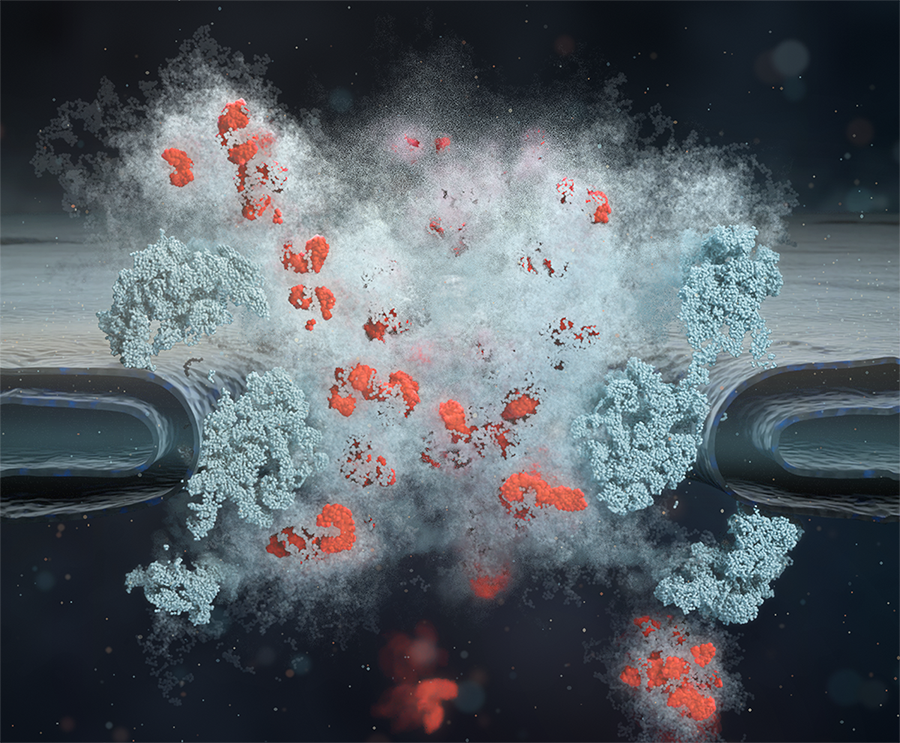
Our genetic material is contained in the nucleus of our cells, which is well-protected by a double membrane. All molecules wishing to pass through must thread their way through one of several thousand nuclear pores. The structure of these pores is well known. However, exactly how molecules are transported through them remains the subject of much debate. A team of researchers led by Prof. Edward Lemke and Prof. Gerhard Hummer have now shed light on the matter. “For the first time, we have been able to measure protein dynamics within the nanocanal of a living cell and demonstrate that the interior of this canal is fluid-like,” says Edward. The researchers at the MPI-BP, in turn, have succeeded in creating the most comprehensive simulation model of a nuclear pore to date, based on the results from Edward and his team. In particular, this model answers the question of the transport pathway through the pore. “These complex calculations were made possible by JUPITER, Europe’s first exascale supercomputer, at the Jülich Research Centre,” says Gerhard. The researchers published their findings in the journal Nature. “As the nuclear pore protects the genome and controls all exchange between the cell nucleus and the cytoplasm, it is one of the most important molecular machines in the human cell,” says Prof. Miao Yu (Wuhan University, China), co-first author of the study. “And also one of the most complex,” adds co-first author Maziar Heidari (MPI-BP).
Fluorescent dyes as probes
Anyone travelling to a town in the Middle Ages first had to pass through one of the town gates – and some might well have been turned away there. The situation at the nuclear membrane, which protectively surrounds the cell nucleus containing valuable genetic information, is comparable in a certain sense. If messenger molecules or pathogens wish to pass through, the only route is via the nuclear pores, each of which checks tens of thousands of ‘visitors’ per minute. Whilst certain molecules are specifically permitted to pass through, others are held back. Essential to this selection process is a barrier of proteins that fills the opening – that much was already known. However, opinions differed widely regarding the exact nature of this barrier: studies on isolated proteins yielded varying results, suggesting the presence of stretched polymers to liquid-like condensates and even solid-like gels with a consistency similar to that of gummy bears. “However, such studies did not allow direct conclusions to be drawn about how the barrier behaves within the living cell,” says Edward. How dynamic are these protein chains anchored in the pore within their natural environment? Do they act more like a rigid comb, or are they soft and flexible like yoghurt or a liquid? And to what extent do their dynamics contribute to selective transport? Such questions have remained unanswered until now.
To find answers, Edward and his team specifically coupled fluorescent dyes to the proteins in the nuclear pores as probes: these could be visualised as tiny glowing dots whose mobility reveals a great deal about the dynamics of the proteins. “As the dyes move extremely quickly, the state inside the nuclear pores must be fluid-like,” says Edward.
What keeps the barrier fluid
In living cells, the proteins remained highly mobile throughout the entire two-hour observation period. The team compared these results with an in vitro model, i.e. with isolated proteins in a test tube. There, however, the protein mass invariably turned into a rigid ‘gummy bear’ or even a solid after about two hours, resembling the deposits found in the brains of people with neurodegenerative diseases such as Alzheimer’s or Parkinson’s. “This was a decisive turning point: there had to be something keeping the barrier in the cells dynamic,” says Edward. The solution to the puzzle: on the one hand, a transport receptor is required; on the other, the barrier’s proteins must be glycosylated – that is, modified with sugar groups – so that they do not stick together too strongly. “When we add these two components, we observe mobility in the model system similar to that in the nuclear pores of living cells,” says Edward.
Transport primarily via the edge of the pore
Another unanswered question concerned the transport route. Whilst the flow velocity in pipes or rivers, for example, is higher in the centre than at the edges, earlier studies suggested that the opposite is true in nuclear pores. The scientific community’s hypothesis was that there must be a biological reason for this – such as a plug in the centre of the pore. The researchers led by Gerhard carried out simulations to investigate this. They based their work on the degree of interconnectedness that the Mainz team had determined in their experiments. “The simulations confirm that the main transport route runs along the edge of the pore,” says Gerhard. “Whilst we do not rule out a biological cause such as a plug, it is not necessary from a physicochemical point of view.” The findings are not only important for a fundamental understanding of how human cells function, but also help us better understand neurodegenerative processes, which also involve the hardening of previously flexible proteins into insoluble plaques.
Further details
Read the full paper here: https://doi.org/10.1038/s41586-026-11258-0
Edward Lemke is an Adjunct Director at the Institute of Molecular Biology (IMB) and a Professor of Synthetic Biophysics at Johannes Gutenberg University Mainz. Further information about research in the Lemke lab can be found at www.imb.de/lemke.
This study was funded by the Deutsche Forschungsgemeinschaft (German Research Foundation, DFG) via the Collaborative Research Center 1551 and European Research Council (ERC), among others.
About the Institute of Molecular Biology gGmbH
The Institute of Molecular Biology gGmbH (IMB) is a centre of excellence in the life sciences that was established in 2011 on the campus of Johannes Gutenberg University Mainz (JGU). Research at IMB focuses on the cutting-edge fields of epigenetics, genome stability, ageing and RNA biology. The institute is a prime example of successful collaboration between a private foundation and government: The Boehringer Ingelheim Foundation has committed 154 million euros to be disbursed from 2009 until 2027 to cover the operating costs of research at IMB. The State of Rhineland-Palatinate has provided approximately 50 million euros for the construction of a state-of-the-art building and is giving a further 52 million in core funding from 2020 until 2027. For more information about IMB, please visit: www.imb.de.
About the Centre for Healthy Ageing
The Centre for Healthy Ageing (CHA) is a virtual research centre established in 2021. It brings together scientists in basic and clinical research from across Mainz who focus on ageing and age-related diseases. Participating researchers are from the Institute of Molecular Biology (IMB), which is also responsible for coordinating the CHA, Johannes Gutenberg University Mainz (JGU), its University Medical Center (UMC), the Leibniz Institute for Resilience Research (LIR), and Translational Oncology Mainz (TRON). Research at the CHA aims to promote healthy ageing and spark discoveries that could lead to the development of treatments to prevent or cure age-related diseases. For more information, please visit www.cha-mainz.de.
About Johannes Gutenberg University Mainz
Johannes Gutenberg University Mainz (JGU) is a globally recognized research-driven university with around 31,000 students from over 120 nations. Its core research areas are in particle and hadron physics, the materials sciences, and translational medicine. JGU's success in Germany's Excellence Strategy program has confirmed its academic excellence: In 2018, the research network PRISMA+ (Precision Physics, Fundamental Interactions and Structure of Matter) was recognized as a Cluster of Excellence – building on its forerunner, PRISMA. Moreover, excellent placings in national and international rankings as well as numerous honors and awards demonstrate the research and teaching quality of Mainz-based researchers and academics. Further information at www.uni-mainz.de.
Boehringer Ingelheim Foundation
The Boehringer Ingelheim Foundation is an independent, non-profit organization that is committed to promoting the medical, biological, chemical, and pharmaceutical sciences. It was established in 1977 by Hubertus Liebrecht (1931–1991), a member of the shareholder family of the Boehringer Ingelheim company. Through its funding programmes Exploration Grants, Plus 3, and Rise up!, the Foundation supports excellent scientists during critical stages of their careers. It also endows the prestigious Heinrich Wieland Prize and awards for emerging scientists. Additionally, it funds institutional projects combining AI and biomedicine, such as the AITHYRA institute in Vienna and a new research unit at the Center for Systems Biology in Dresden (BioAI Dresden). Other supported institutions include the Institute of Molecular Biology (IMB) in Mainz and the European Molecular Biology Laboratory (EMBL) in Heidelberg, both in Germany.
Press contact for further information
Dr Ralf Dahm, Director of Scientific Management
Institute of Molecular Biology gGmbH (IMB), Ackermannweg 4, 55128 Mainz, Germany
Phone: +49 (0) 6131 39 21455, Email: press(at)imb.de